Saturday, July 21, 2012

catasetum penang red? hahahaha

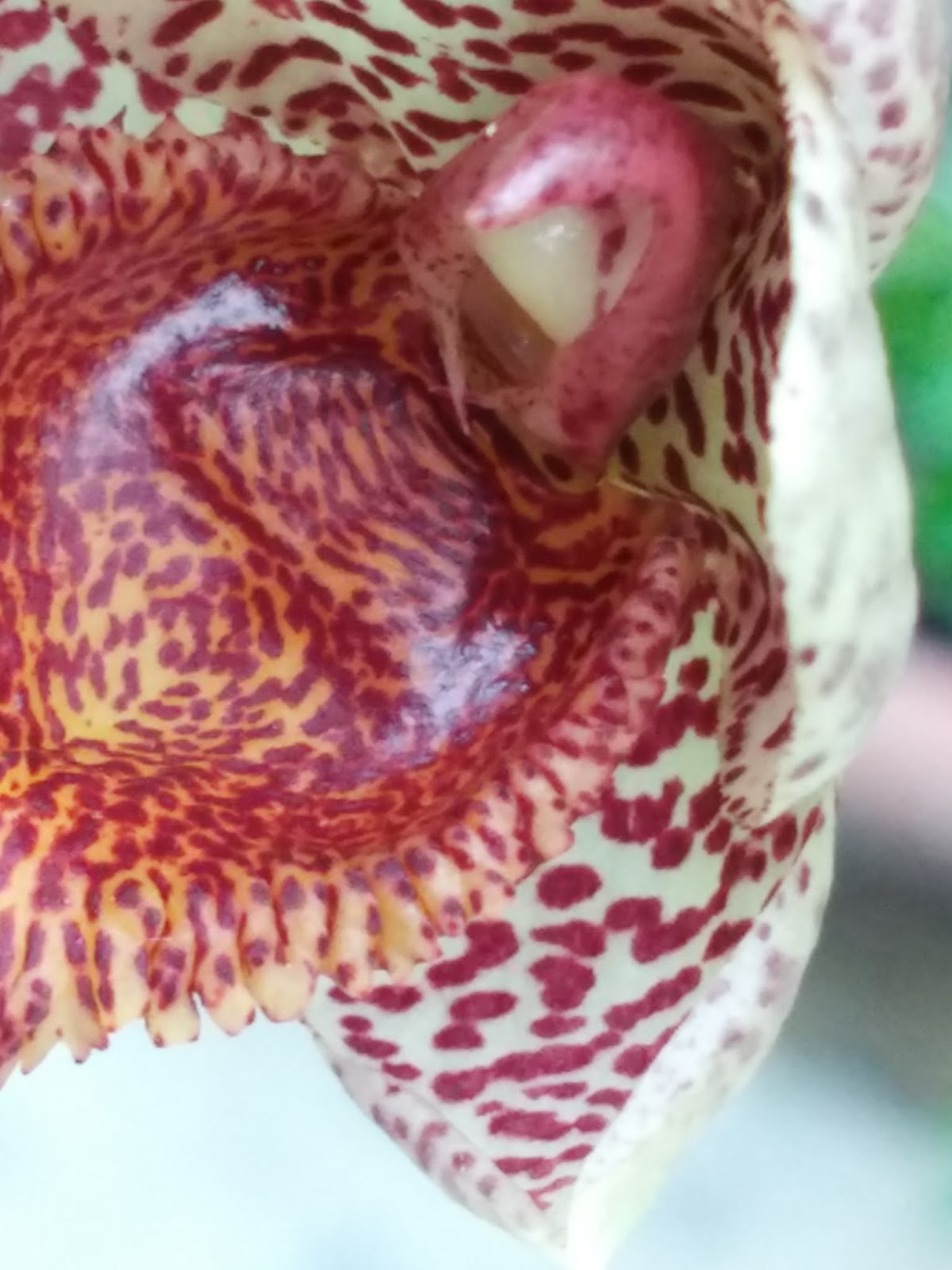
most will be thinking that i got this post mislabeled but actually not. i choose this plants among the hundreds of deflasked seedlings of catasetum penang red but this is what the flower turns out to be.
it is a penang for sure but the first question that arise is whether is it an alba form? IMHO, i do not think this one is an alba form, maybe just that it got more of the white pileatum gene in it.
as the flowers matures, the white hue in the flower is dominating more and more, i had a similar ctsm penang but that one is more of yellow and white as the flower matures


 first pic below, the entire plant (initially with 6 buds but i accidentally broke one white watering the others)
pic 2 and 3 is the appearance of the spike in closer view
fourth pic closeup of the individual flower

last pic here showing the callus present at the ventral of the depression of the labellum


Sunday, July 1, 2012

catasetum macroglossum

the word macroglossum refers to the large lip structure of the flower. this flower is non resupianted, had a sweet fragrance. the large lip structure extends till the beak anther and covers it laterally. inflorescence is arching and becomes lightly pendant with the weight of the flower. this species is easily identified from the two teeth like structure at the mid lobe of the labellum and also a semi circular callus that is present just at the inner apex of the lip (cannot be visualize from frontal view).


 first pic below the plant and the entire spike

second pic, the spike itself, 6 of them


closeup on the individual flower 

lateral view

close up on the hood with the two fang/teeth like structure, each beside the pointy tip of the labellum


 closeup on the inner side just under the apex of the hood, showing the semicircle callus (dark yellow in color)

Friday, June 29, 2012

catasetum denticulatum, part two

just bloomed today, 11 of them, first spike from this first division of backbulb. its name is derived from the word denticulatus, referring to the toothed margin of the labellum. this species belongs to the clustered flowers of pendant inflorescence, like the cirrhaeoides or pulchrum. both the plant and flowers are small, the size of the flower is shown as below and the pseudobulb ranges from 2inches to nearly 7inches in adult. mine currently is near to 4 inches only. 


flower size is basically small, about an inch when the lateral sepals are fully bloom


last pic below showing the small tooth like structure on the margin of labellum


The below two pics here is taken on 27/8/2017. Though this species had bloomed multiple times but I never notice the callus on the labellum, until it caught my attention yesterday.


Thursday, June 28, 2012

At times, small sacrifices are necessary; Part TWO

seems like so far all of them made it (looking for a big piece of wood to touch now :D ). first of all my apologies for this post have no showy flowers to offer. basically all the pics are the the resultant of the bulbs that i salvaged, (pics is in previous post  http://www.blogger.com/blogger.g?blogID=2935788560972723913#editor/target=post;postID=7124565221887978501  )

the first pic here is the bulb from the first part of this post where is held it on my palm, a new growth, actually its the second growth. the first growth died from bulb rot which i presume is a extended infection from the original bulb. this batch really had some nasty bugs with it, for not only this plant is affected in this manner, i had three others also suffered from the same fate) but fortunately the second rotten bulb give out a new growth from the base and i really hope no more bulb rot!! i don't think there is enough food storage in the primer bulb left, it is only barely 2inches and after the second growth, i can see signs of yellow of the backbulb.
 second pic, the bulbs are weak so they only manage to give rise to a small subsequent bulb, but at least they are in dormant phase (to me, this is considered 'touch down'), something like a safe point for them. since the infection is controlled, this division should be doing better in subsequent cycle.
 the pic below shows new growth, i got to remove the backbulb prematurely because it is rotting away when the new growth is very immature and seems like it made it. the new growth is starting to form the bulb on its own, hopefully will continue to do so.
 this is one of healthier plants among the batch that i got, from the first bulb, a smaller second bulb is almost mature and at the same time giving rise to a new growth. you can see here that the new growth is robust, eventually will be a larger bulb than its predecessor. all thanks to the second healthy bulb.
 the two pics below basically is the best from this batch, slight fungal problem on the leaves as they grow but easily controlled with mancozeb. and the two small bulbs in the last pic even presented me with two spikes (one each) during the first growth. they are the catasetum cirrhaeoides (http://www.blogger.com/blogger.g?blogID=2935788560972723913#editor/target=post;postID=4078604512162977102)

well, seems like the six made it, and basically this is one of the worst batch of catasetum i had ever obtained so far!! but on the other hand, they had also taught me a lot in this little misadventure and most important, all of them made it.
as a conclusion, sometimes we got to be bold to take drastic salvage procedure if the plant that we obtained is infected, this means cutting them down to individual single bulb if you had to. sometimes the 'wait and see' approach would caused one great casualty in the end.   

Sunday, June 17, 2012

catasetum tenebrosum

derived from the word tenbrosa which refers to the meaning dark or gloomy. this species is easily identified from its labellum, triangular in shape, color is either yellow, pale green or chartreuse. there should be two prominent callus on the labellum, one at the base and the other at the apex.
this particular division is special to me because it is derived from a very old shriveled backbulb. also from this experience that taught me not to waste any old babkbulb (some may not agree as it takes a long time to develop an established plant from a weak bulb, however this experience had taught me to save some very important plant in my collection).
it took me two years to established this plant from this single shriveled bulb (in first pic). the spike is with 13 flowers, color of the outer sepals are darker than the inner petals and sepals.


will add in more pic tomorrow of the entire plant and also when the flower blooms fully
here are more of the pic taken today, showing the entire plant and also the bloom

the pic below (lip close up, showing the double callus labellum)

the condition of the plant now, with four bulbs

appearance of the entire spike

individual flower


Sunday, June 3, 2012

update on second attempt on flasking media

this is an update on the post about second attempt on flasking media (for those who had not seen the post, the link is below)

http://www.blogger.com/blogger.g?blogID=2935788560972723913#editor/target=post;postID=7572603322440353753

some cauliflower like mass are growing, but somehow still not convincing enough for me to say these are protocorn bodies. they should be green by now if these are protocorns. all i can see is for the past 3weeks, several small island of these cauliflower growth are popping up but are growing very slowly.
well, still keeping my finger cross. will update if they are turn out to be protocorns.


Tuesday, May 29, 2012

catasetum naso

sorry to those who read the earlier post about this that is labelled as catasetum sanguineum. i bought this plant labelled as catasetum sanguineum,
catasetum naso and sanguineum looks similar in the sense that both the lip are trilobe, non resupinated, erected peduncle and have a nose like projection at the tip of the lip. however, the borders of the lateral lobes of sanguineum is fully lacerate while catasetum naso's borders are only lacerate near the base. the second most distinguishing character is the pedicles, sanguineum measures only about 10mm while catasetum naso have a longer peidcle of 20mm.
in addition to that, sanguineum flowers are more densely packed at the end of the inflorescence while catasetum naso has flowers that are separated by bracts that are about 30mm apart.
so base on these description, conclusion is made that this plant is Catasetum naso and not sanguineum

on the left of the first pic is a hermaphrodite flowers, and the right one is the male flower


 second pic on the left shows the lateral lobes of the labellum that is serrated and curves inwards to form an almost complete circle that is interrupted by the trigger pollina. the lateral view shows the prominent nose like projection from the apex of the labellum,

the last pic below showing the detail lip appearance of the labellum from inside