Thursday, September 13, 2012

Catasetum callosum - 2

this catasetum species originate from Brazil, Amazonas state and Venezuela. fairly easy to grow and not to mentioned hardworking bloomer as well.
the dorsal sepal and petals are fused, acuminate in shape but are separate in other clones. the antennae are parallel flank the callus at the base of the lip as they pass by. the edge of the labellum are faintly hairy with a small sac depression.

the plant and the spike, 13 of them this time

 image below showing the individual flower, the parallel antennae, and the accuminated dorsal sepal and petals are evident

 lateral view of the flower, the sac depression on the lateral view is clear in this view as well as the side view of the conical callus, just above the sac of the lip

the width of the flower measures about 2inches width

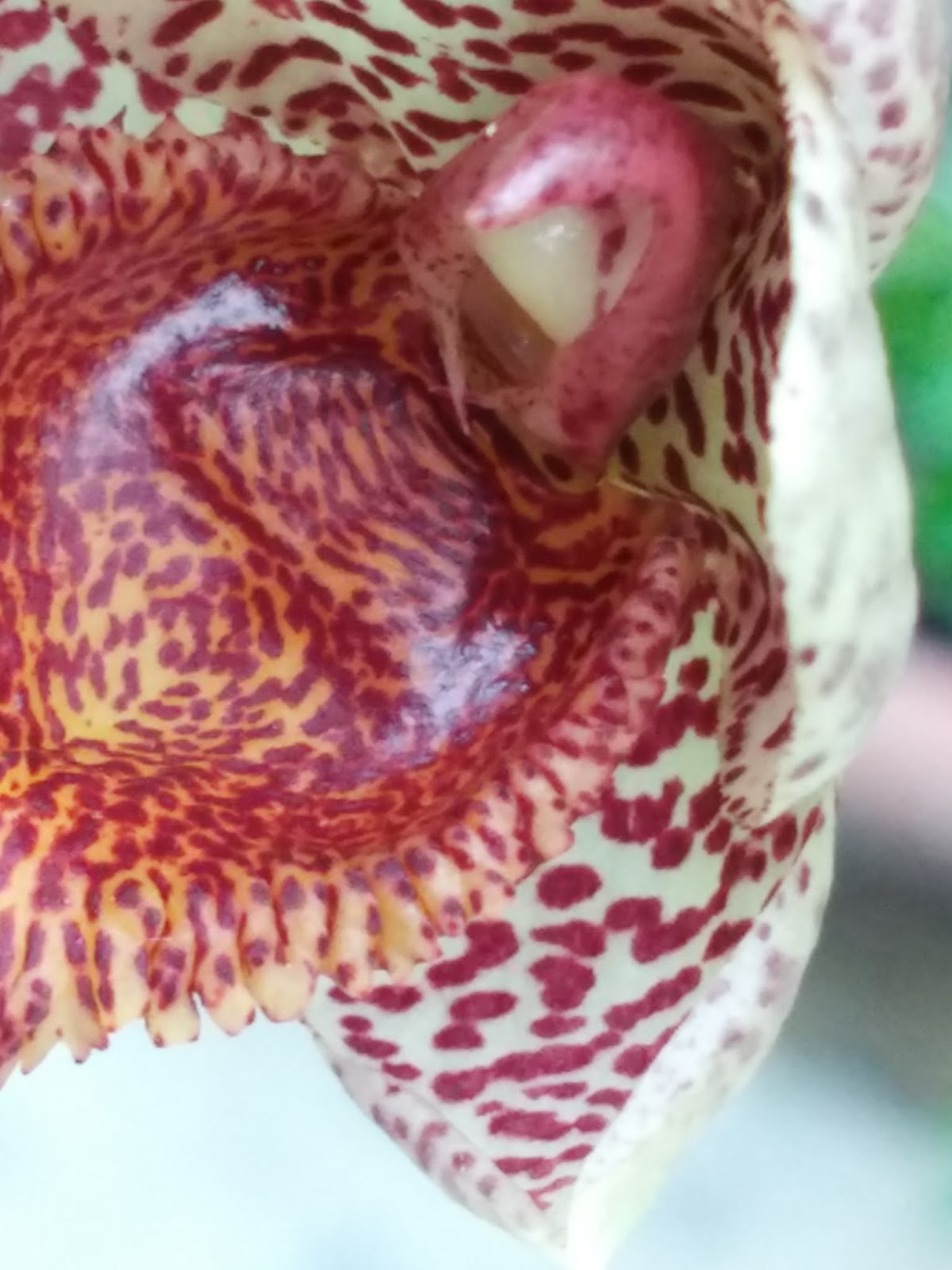
close up of the lip showing the callus, located just above the sac of the labellum

measurement of the side view of the flower

measurement of the lip

slight oblique view on the lip, antennae, sac of the labellum and part of the column

second spike is emerging at the same time, keeping my finger cross that it would be more than 13 this time, LOL

Sunday, September 2, 2012

Catasetum memoria kampar yip

bought this plant with the label "ctsm macrocarpum" but the moment i saw the red specks on the outer petal before the flower opens, i know for sure it is a mistakenly labelled plant!
this however did not turn out to be a major disappointment because this hybrid is in my wishlist. catasetum memoria kampar yip is a cross between catasetum tuanku zainab petra and catasetum susan fuchs; the former is a cross between catasetum sumani (ctsm pileatum x ctsm saccatum) and catasetum fimbriatum. so i guess we know where this hybrid got its fimbriated lip margin from,
this plant was named in memory of the late orchid enthusiast Mr Yip from Kampar, Malaysia. this hybrid was registered on 3/3/1993. the seed pollen is from catasetum susan fuchs on the registra but as usual even a reciprocal cross between the catasetum tuanku zainab petra and catasetum susan fuchs would also be known as catasetum memoria kampar yip.
spike of 9 with very strong cinnamon like smell, could even smell it from several feet away. love the coloration and pattern of this hybrid, with distinct color markings.


blooms on 25/7/14


Saturday, September 1, 2012

catasetum pileatum 'snow cup'

this is the pileatum i like the most, the white pileatum. the came came from the latin word 'pileatus' which means bonnet shape, referring to the large concave lip of the flower. therefore a pileatum should always have a concave lalbellum. this flower was the national flower of Venezuela until 1921.
no callus should be present on the labellum of a pileatum, and the lip should be concave, maybe flatter in some clones but never folds to the back. any presence of calluses or backward folding of the lip is usually a hybrid rather than a pure pileatum. most of the pileatum has longitudinal ribs that runs vertically down from the sac depression of the labellum.
the flowers are large, i am not sure if it is the largest among the catasetums but it is definitely the largest in my collection, the buds started out with light green color and the color gradually turn whitish and eventually white as it matures.
below are a few pics from this plant of mine, showing the gradual coloration changes of the flower bud as it opens. the bulb of this plant is currently slightly over 10inches and it is 31inches plus from base of the bulb till the apex of the leave. a very robust plant and i do hope it will continue to grow bigger in the subsequent cycle.


 the green bud below is the appearance of the flower bud before full maturity, it is greenish in color and the coloration gradually turns white as the bloom matures

the appearance at full bloom

just a close up on the anther beak structure (just toying around with the camera)

 these are large flowers, the height is near to 10cm and the width is 8cm
appearance of the entire plant, not shown here but the second spike is emerging. =)


size of the bulb is 10inches plus, near to 11. so far this one is the record holder in my collection for catasetums

Saturday, July 21, 2012

catasetum penang red? hahahaha

most will be thinking that i got this post mislabeled but actually not. i choose this plants among the hundreds of deflasked seedlings of catasetum penang red but this is what the flower turns out to be.
it is a penang for sure but the first question that arise is whether is it an alba form? IMHO, i do not think this one is an alba form, maybe just that it got more of the white pileatum gene in it.
as the flowers matures, the white hue in the flower is dominating more and more, i had a similar ctsm penang but that one is more of yellow and white as the flower matures


 first pic below, the entire plant (initially with 6 buds but i accidentally broke one white watering the others)
pic 2 and 3 is the appearance of the spike in closer view
fourth pic closeup of the individual flower

last pic here showing the callus present at the ventral of the depression of the labellum


Sunday, July 1, 2012

catasetum macroglossum

the word macroglossum refers to the large lip structure of the flower. this flower is non resupianted, had a sweet fragrance. the large lip structure extends till the beak anther and covers it laterally. inflorescence is arching and becomes lightly pendant with the weight of the flower. this species is easily identified from the two teeth like structure at the mid lobe of the labellum and also a semi circular callus that is present just at the inner apex of the lip (cannot be visualize from frontal view).


 first pic below the plant and the entire spike

second pic, the spike itself, 6 of them


closeup on the individual flower 

lateral view

close up on the hood with the two fang/teeth like structure, each beside the pointy tip of the labellum


 closeup on the inner side just under the apex of the hood, showing the semicircle callus (dark yellow in color)

Friday, June 29, 2012

catasetum denticulatum, part two

just bloomed today, 11 of them, first spike from this first division of backbulb. its name is derived from the word denticulatus, referring to the toothed margin of the labellum. this species belongs to the clustered flowers of pendant inflorescence, like the cirrhaeoides or pulchrum. both the plant and flowers are small, the size of the flower is shown as below and the pseudobulb ranges from 2inches to nearly 7inches in adult. mine currently is near to 4 inches only. 


flower size is basically small, about an inch when the lateral sepals are fully bloom


last pic below showing the small tooth like structure on the margin of labellum


The below two pics here is taken on 27/8/2017. Though this species had bloomed multiple times but I never notice the callus on the labellum, until it caught my attention yesterday.


Thursday, June 28, 2012

At times, small sacrifices are necessary; Part TWO

seems like so far all of them made it (looking for a big piece of wood to touch now :D ). first of all my apologies for this post have no showy flowers to offer. basically all the pics are the the resultant of the bulbs that i salvaged, (pics is in previous post  http://www.blogger.com/blogger.g?blogID=2935788560972723913#editor/target=post;postID=7124565221887978501  )

the first pic here is the bulb from the first part of this post where is held it on my palm, a new growth, actually its the second growth. the first growth died from bulb rot which i presume is a extended infection from the original bulb. this batch really had some nasty bugs with it, for not only this plant is affected in this manner, i had three others also suffered from the same fate) but fortunately the second rotten bulb give out a new growth from the base and i really hope no more bulb rot!! i don't think there is enough food storage in the primer bulb left, it is only barely 2inches and after the second growth, i can see signs of yellow of the backbulb.
 second pic, the bulbs are weak so they only manage to give rise to a small subsequent bulb, but at least they are in dormant phase (to me, this is considered 'touch down'), something like a safe point for them. since the infection is controlled, this division should be doing better in subsequent cycle.
 the pic below shows new growth, i got to remove the backbulb prematurely because it is rotting away when the new growth is very immature and seems like it made it. the new growth is starting to form the bulb on its own, hopefully will continue to do so.
 this is one of healthier plants among the batch that i got, from the first bulb, a smaller second bulb is almost mature and at the same time giving rise to a new growth. you can see here that the new growth is robust, eventually will be a larger bulb than its predecessor. all thanks to the second healthy bulb.
 the two pics below basically is the best from this batch, slight fungal problem on the leaves as they grow but easily controlled with mancozeb. and the two small bulbs in the last pic even presented me with two spikes (one each) during the first growth. they are the catasetum cirrhaeoides (http://www.blogger.com/blogger.g?blogID=2935788560972723913#editor/target=post;postID=4078604512162977102)

well, seems like the six made it, and basically this is one of the worst batch of catasetum i had ever obtained so far!! but on the other hand, they had also taught me a lot in this little misadventure and most important, all of them made it.
as a conclusion, sometimes we got to be bold to take drastic salvage procedure if the plant that we obtained is infected, this means cutting them down to individual single bulb if you had to. sometimes the 'wait and see' approach would caused one great casualty in the end.